

If you’re currently running Sophos EDR but already invested in Microsoft 365, you’re likely evaluating more than just detection performance. You’re evaluating platform strategy.
Does it still make sense to operate a standalone endpoint tool, or is it time to consolidate into Microsoft Defender for Endpoint and activate the broader Microsoft security ecosystem you may already be funding?
For Microsoft-centric businesses, this decision is rarely about sacrificing protection. It’s about simplifying architecture while strengthening cross-domain visibility.
Where Sophos EDR and Defender Overlap
At the endpoint level, both platforms are mature and capable.
Sophos EDR is well regarded for behavioral detection, anti-ransomware protection (including CryptoGuard), and managed detection and response (MDR) options. Defender for Endpoint Plan 2 delivers comparable core capabilities:
Independent testing supports Defender’s enterprise credibility. In evaluations by MITRE ATT&CK, Microsoft Defender has demonstrated broad visibility across attack techniques. Additionally, Gartner has positioned Microsoft as a Leader in Endpoint Protection Platforms for multiple consecutive years.
From a pure endpoint protection standpoint, Defender is competitive with Sophos. But endpoint-only comparisons miss the larger architectural opportunity.
Where Defender Extends Beyond Sophos
Identity-Native Security
Defender integrates deeply with Microsoft Entra ID.
That means risky sign-ins, credential theft, and privilege escalation signals can automatically influence device risk scoring and Conditional Access policies.
In modern attack chains, identity compromise often precedes ransomware deployment. Native identity + endpoint correlation reduces lateral movement and speeds containment.
Sophos can ingest identity data, but it does not operate the identity control plane.
Email and Collaboration Integration
Defender connects directly with:
- Microsoft Defender for Office 365
- Microsoft Exchange Online
- Microsoft Teams
Phishing attacks can automatically trigger endpoint investigation, user isolation, and remediation workflows inside a unified incident view.
For Microsoft 365 customers, this cross-domain automation materially reduces investigation time.
Unified XDR Architecture
Microsoft Defender XDR unifies:
- Endpoint
- Identity
- SaaS apps
- Cloud workloads
Microsoft reports that businesses using XDR platforms can reduce mean time to respond (MTTR) by up to 50% compared to siloed tools. While individual results vary, consolidating telemetry into a single incident experience consistently reduces operational friction.
The advantage is signal correlation without heavy integration work.
Licensing: When Defender Can Replace Sophos EDR
Defender for Endpoint can fully replace Sophos EDR in most Microsoft-centric environments when you have:
For businesses already licensed for E5 or Business Premium, endpoint security may already be included in your subscription. Maintaining Sophos alongside Defender can represent duplicative spend.
In mid-sized and enterprise environments, replacing third-party EDR across hundreds or thousands of endpoints can produce meaningful annual cost savings, often compounding over a 3-year contract cycle.
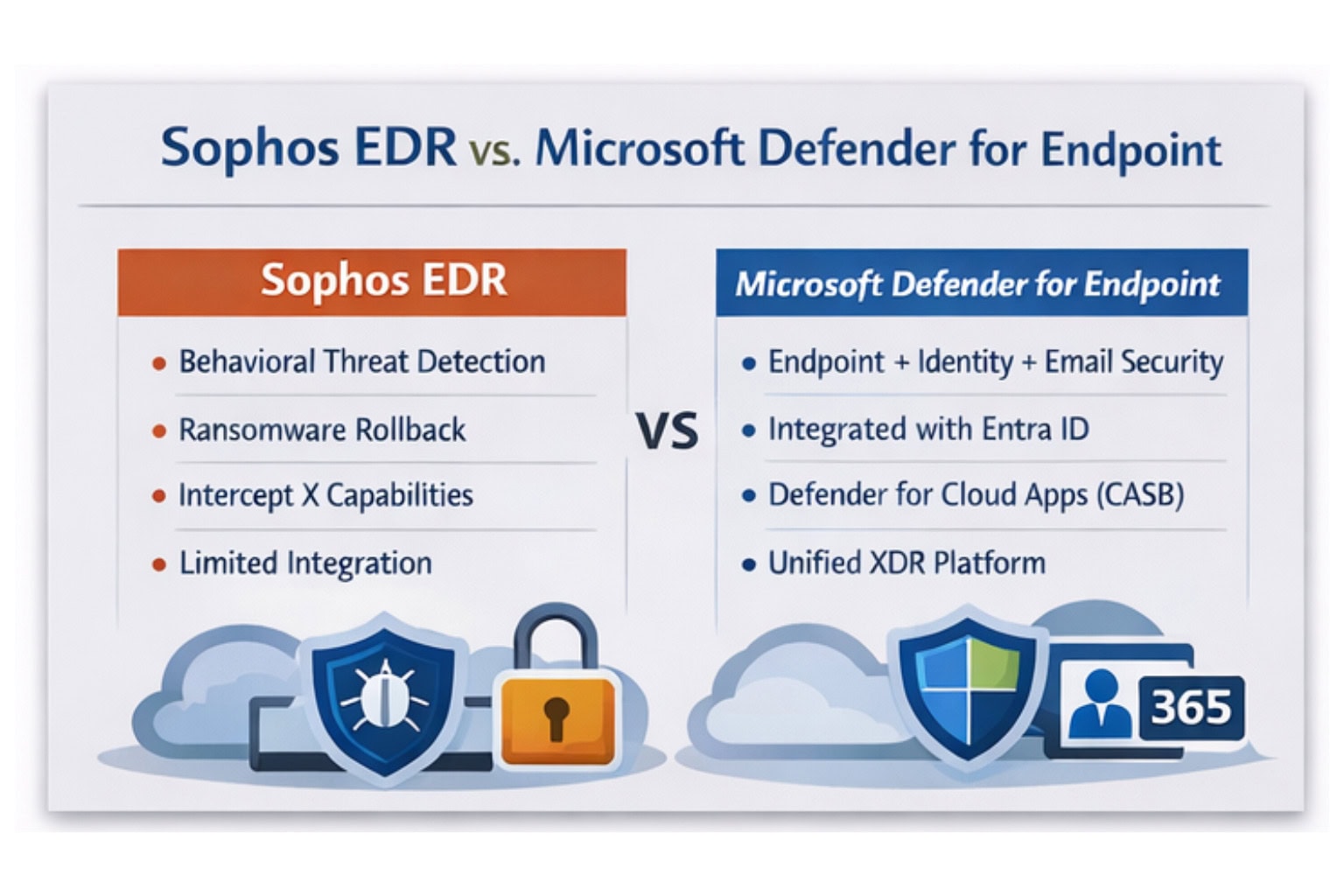
Cost Comparison (1,000 Endpoints)
| Cost Category | Microsoft Defender for Endpoint (E5 Licensed) | Sophos Intercept X (Standalone EDR) |
|---|---|---|
| Endpoint License Cost | $0 incremental (included in E5) | $35,000–$75,000 annually |
| CASB (Cloud Visibility) | Included (Defender for Cloud Apps) | Separate add-on license required |
| Email Security Integration | Included (Exchange Online Protection & Defender for Office 365) | Separate email security product required |
| Identity Risk Correlation | Included (Entra ID & Identity Protection) | Limited / external integration |
| XDR Capabilities | Unified XDR across endpoint, identity, email, cloud | Additional licensing required for full XDR |
| Console Consolidation | Single unified security portal | Separate management console |
| Estimated 3-Year Cost (EDR Only) | $0 incremental (if already E5) | $105,000–$225,000 |
Licensing: When Defender Can Replace Sophos EDR
Defender for Endpoint can fully replace Sophos EDR in most Microsoft-centric environments when you have:
For businesses already licensed for E5 or Business Premium, endpoint security may already be included in your subscription. Maintaining Sophos alongside Defender can represent duplicative spend.
In mid-sized and enterprise environments, replacing third-party EDR across hundreds or thousands of endpoints can produce meaningful annual cost savings, often compounding over a 3-year contract cycle.
When Migration Makes Strategic Sense
Defender tends to be the stronger long-term play when:
A move from Sophos EDR to Defender is particularly compelling when:
In these environments, consolidation increases visibility rather than reducing it.
How to Migrate from Sophos EDR to Defender for Endpoint
A structured approach ensures continuity and avoids protection gaps.
Begin by validating licensing to confirm Defender for Endpoint Plan 2 (or Defender for Business) availability. Deploy Defender in passive mode alongside Sophos 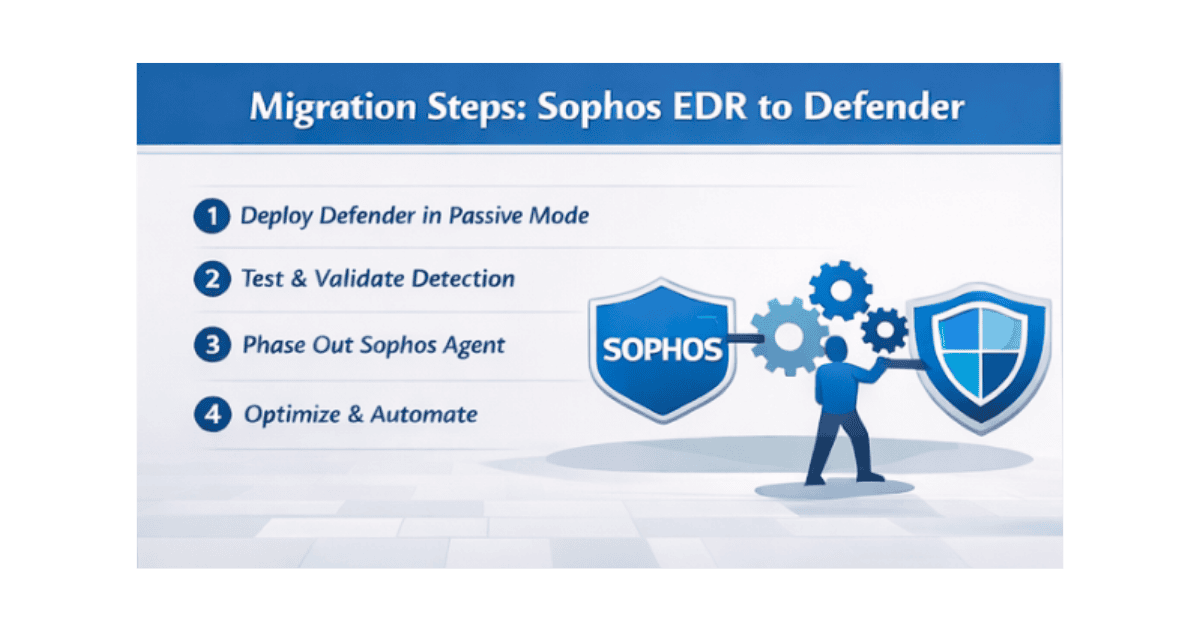 to compare detections and validate performance.
Next, enable integration across identity, email, and cloud apps to activate full XDR correlation. Conduct simulation exercises to validate automated remediation workflows.
Once confident in coverage, remove the Sophos agent in controlled phases while monitoring detection telemetry. Finalize the transition by tuning attack surface reduction (ASR) rules, enabling automated investigation, and aligning Conditional Access policies with device risk scoring.
The objective is activating a unified security platform.
Frequently Asked Questions
Conclusion
Security maturity is not about stacking tools. It’s about how effectively they work together.
For Microsoft-centric businesses, migrating from Sophos EDR to Defender for Endpoint is rarely about sacrificing protection. It’s about consolidating into a platform that already spans endpoint, identity, email, and cloud, all reducing complexity while strengthening control.
LEARN MORE ABOUT MIGRATING FROM SOPHOS TO DEFENDER

Andrew Reade
Andrew is our Digital Marketing Manager and oversees web-based marketing strategies and content creation for the organization. As a marketing veteran, Andrew has worked with organizations of all sizes in a diverse group of industries, from Risk Management to Transportation. Joining the organization in 2021, Andrew is based in Mobile Mentor’s Nashville, TN office.