

For years, IT budgeting has been relatively predictable.
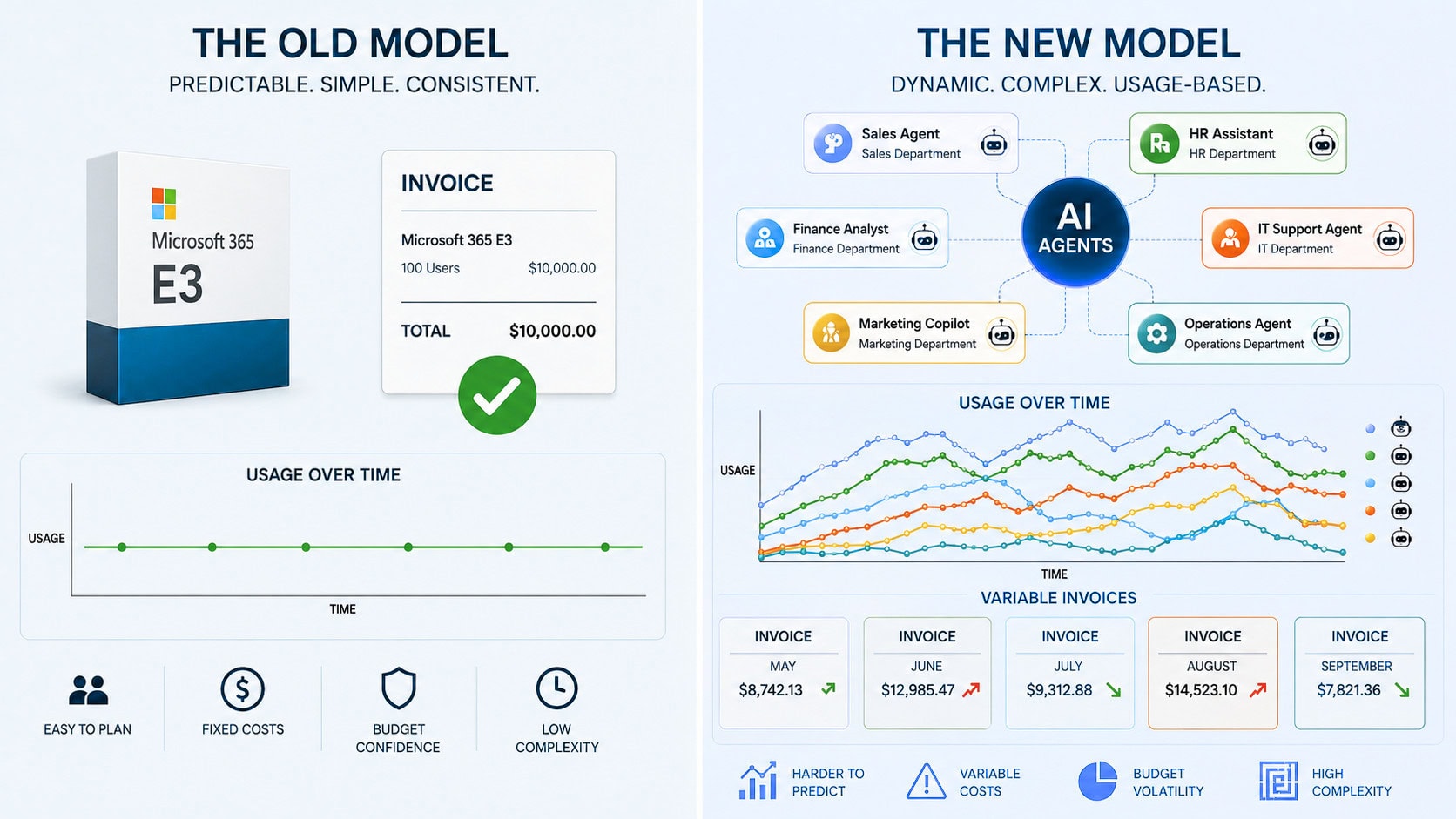
You buy Microsoft 365 licenses. You know how many users you have. You know what you’ll spend each month.
AI is changing that.
Increasingly, businesses are moving from flat-fee licensing to consumption-based billing, where costs depend on how much AI is actually used.
On the surface, this makes perfect sense.
Paying only for what you consume sounds efficient.
In reality, it introduces a whole new challenge.
Predictable Budgets Are Becoming Variable Budgets
Traditional licensing was easy to understand.
100 users.
100 licenses.
One monthly invoice.
Consumption changes the equation.
Now businesses need to answer questions like:
These are questions most finance and IT teams have never had to answer before.
AI Doesn’t Just Consume Licenses. It Consumes Resources.
Today’s AI services are already introducing usage-based pricing.
As businesses begin deploying AI agents, automation, retrieval systems, APIs, and advanced Copilot capabilities, consumption becomes much harder to predict.
One employee may use AI ten times a day.
Another may trigger thousands of automated workflows behind the scenes.
Two users with identical licenses can generate dramatically different costs.
That’s a very different financial model from traditional software.
The Challenge Isn’t the Technology. It’s the Visibility.
The biggest risk isn’t overspending.
It’s not knowing why you’re spending.
Without visibility into usage, businesses struggle to answer basic questions:
As AI becomes embedded across Microsoft 365, Dynamics, Azure, and custom applications, these questions only become more important.
Optimization Will Become as Important as Deployment
The first wave of AI projects has focused on adoption.
The next wave will focus on optimization.
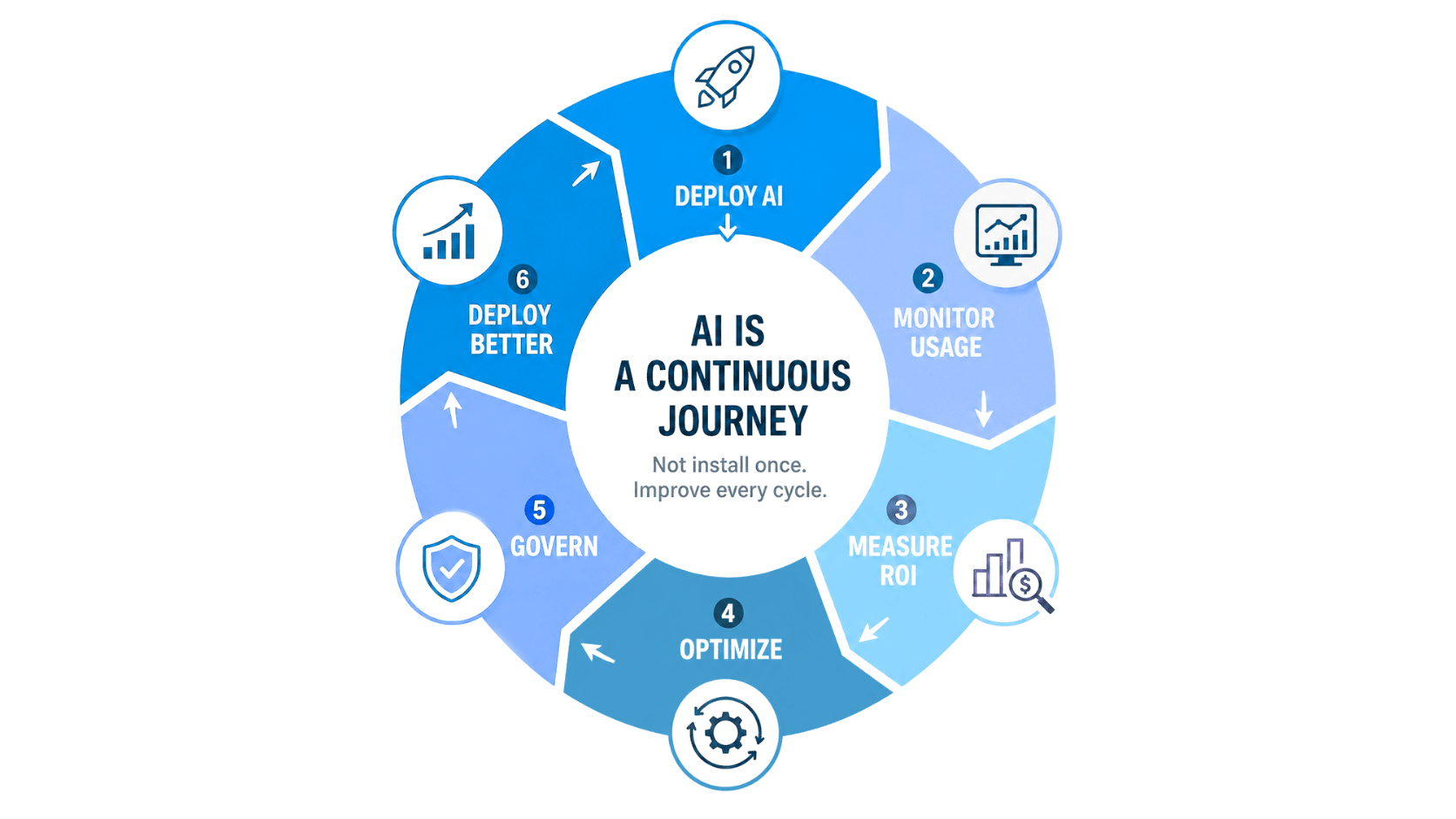
Businesses will need to continuously monitor usage, identify waste, measure business outcomes, and adjust AI deployments over time.
Managing AI costs won’t be a once-a-year budgeting exercise.
It will become an ongoing operational discipline.
Just as businesses learned to optimize cloud infrastructure over the past decade, they’ll now need to optimize AI consumption.
We Feel Your Pain
If all of this sounds complicated, you’re not alone.
We’re having this conversation with customers every week.
The AI pricing landscape is evolving rapidly, and it’s likely to become even more complex before it becomes simpler.
New AI services, autonomous agents, consumption models, and pricing structures are arriving at an incredible pace.
The good news is that businesses don’t have to navigate this alone.
At Mobile Mentor, we’re building services specifically designed to help customers understand, manage, govern, and optimize AI consumption.
Not simply to reduce costs, but to ensure every dollar spent on AI delivers measurable business value.
Because success with AI won’t be determined by who spends the most.
It will be determined by who understands where their AI investment is creating the greatest impact.
Get in Touch With the Mobile Mentor Team to Learn More

Andrew Reade
Andrew is our Digital Marketing Manager and oversees web-based marketing strategies and content creation for the organization. As a marketing veteran, Andrew has worked with organizations of all sizes in a diverse group of industries, from Risk Management to Transportation. Joining the organization in 2021, Andrew is based in Mobile Mentor’s Nashville, TN office.