
For years, identity was a simple concept. An employee signed into an application, accessed the data they needed, and got on with their day.
That model no longer reflects reality.
Today’s digital workplace includes employees, contractors, devices, SaaS applications, automated workflows, and increasingly, AI agents. As businesses embrace Microsoft Copilot, autonomous agents, and AI-powered workflows, identity is rapidly becoming the control plane for the entire enterprise.
The question is no longer Who is logging in?
The question is:
Who, what, or which AI agent is requesting access, what are they allowed to do, and how do we govern that activity?
AI Doesn’t Create Identity Challenges. It Exposes Them.
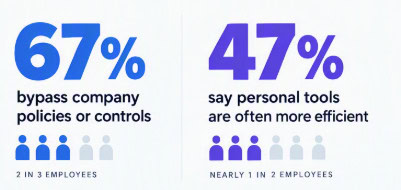
One of the strongest findings from the 2026 Endpoint Ecosystem Study is that employees regularly work around the controls IT puts in place.
These statistics matter because AI is accelerating the same behavior.
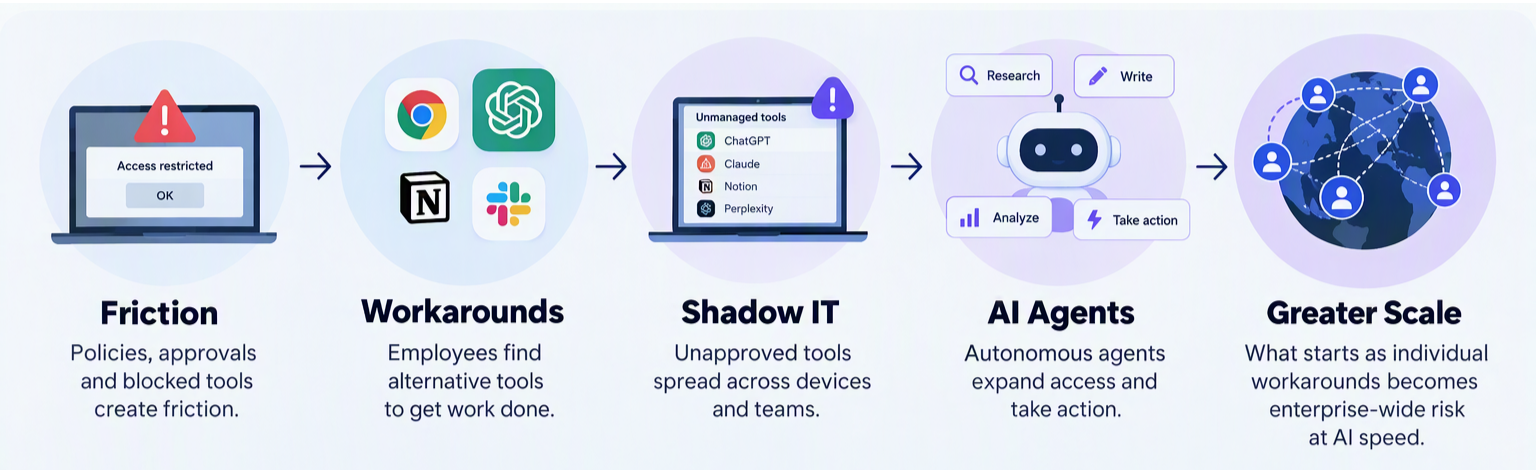
When employees feel constrained, they find alternatives. Today that may mean personal file sharing services, messaging apps, or AI tools. Tomorrow it may mean connecting AI agents directly to corporate systems without the proper governance controls in place.
The challenge isn’t that AI creates a security problem.
The challenge is that AI scales existing security problems much faster.
The Workforce Now Includes Non-Human Identities
Historically, organizations managed human identities.
Today, businesses must manage:
This shift fundamentally changes how identity should be viewed.
AI agents require identities, permissions, access controls, policies, and governance just like employees do.
An AI agent may need access to SharePoint, Teams, CRM systems, financial systems, or internal knowledge repositories. Without clear identity governance, organizations risk creating thousands of new digital workers with excessive permissions and limited oversight.
Identity is no longer a security feature.
It is becoming the foundation of AI governance.
Why Microsoft Entra Matters More Than Ever
Microsoft Entra was originally viewed by many organizations as an identity platform.
Today, it is evolving into something much larger.
Entra is increasingly acting as the control plane for:
This matters because AI cannot be governed separately from the rest of the organization.
Customers do not want another isolated platform to manage AI.
They want the same security controls that govern employees to also govern AI agents.
That means:
In many cases, AI agents should be treated as first-class identities inside the organization.
Zero Trust Was Built for This Moment
The AI era is validating many of the principles Zero Trust advocates have promoted for years.
Never trust. Always verify.
When organizations adopt AI, that principle becomes even more important.
Every access request should answer three questions:
- 1Who is requesting access?
- 2Why do they need access?
- 3Should access be granted right now?
This applies equally to:
- 1Employees
- 2Devices
- 3Applications
- 4AI agents
As organizations introduce autonomous agents capable of taking actions on behalf of users, identity governance becomes the mechanism that keeps those agents operating within approved boundaries.
Without identity-driven controls, organizations risk creating powerful automation without accountability.
Passwords Are Becoming the Weakest Link
The Endpoint Ecosystem Study continues to reveal a significant gap between employee convenience and organizational security.
Password-related risk remains widespread, with many workers prioritizing ease of use over security best practices.
This aligns with what Mobile Mentor sees every day.
Compromised credentials remain one of the most common entry points for attackers.
As a result, organizations are accelerating investments in:
- 1Passkeys
- 2Multifactor authentication
- 3Biometrics
- 4Conditional Access
- 5Passwordless authentication
The future of identity is not another password.
It is proving that a person is who they claim to be through multiple trust signals.
The same principles will increasingly apply to AI agents.
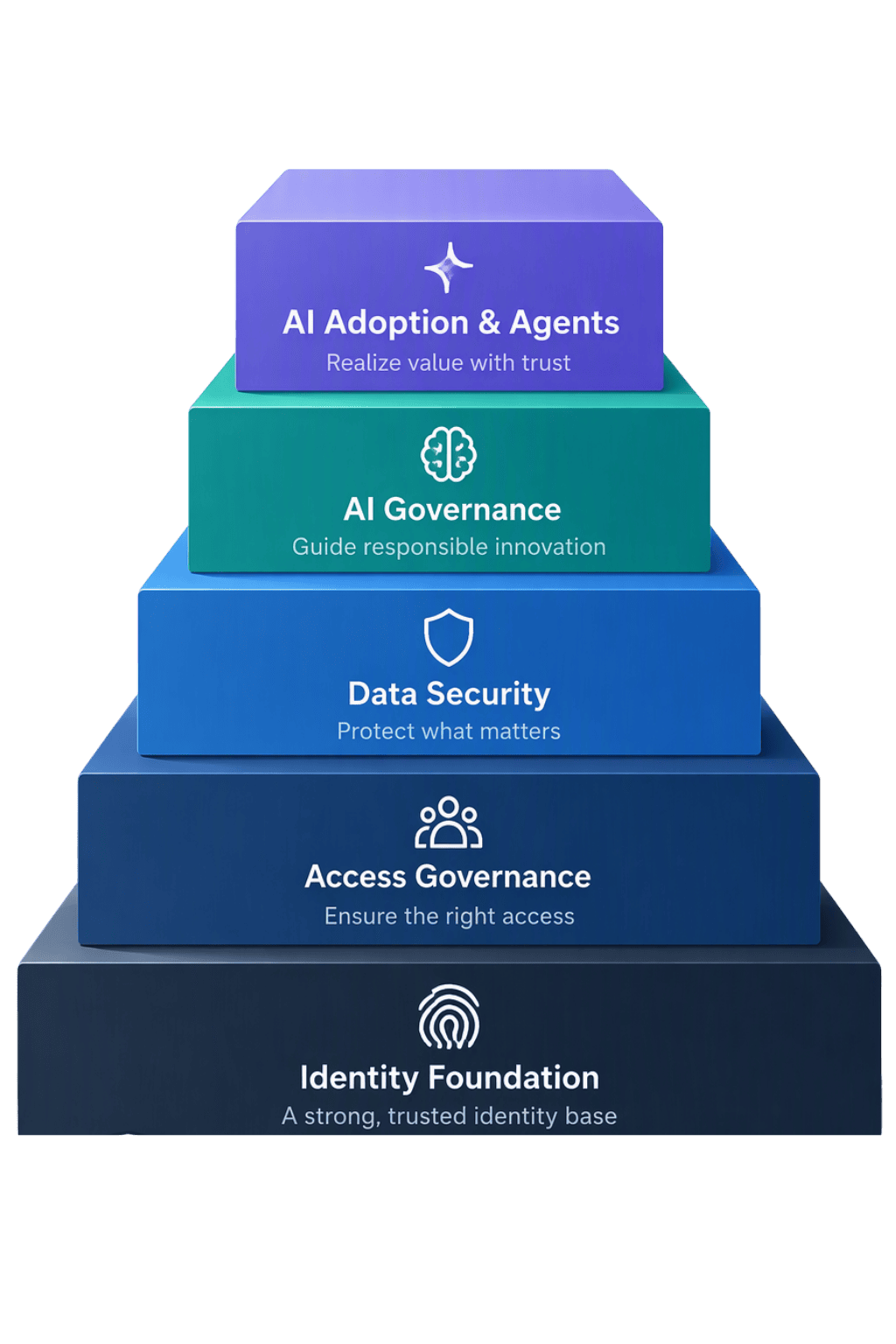
Before You Scale AI, Start with Identity
Many organizations are focused on AI licenses, AI use cases, and AI adoption.
Those are important conversations.
But the businesses that succeed with AI will first establish a strong identity foundation.
That means:
The Endpoint Ecosystem Study found that nearly half of employees either receive no AI training or are unsure whether training exists. At the same time, AI adoption continues to accelerate.
This creates a dangerous situation where organizations move faster on AI deployment than governance.
Identity helps close that gap.
Conclusion
We are entering a workplace where humans and AI agents work side by side.
Every AI agent will need an identity.
Every identity will require permissions.
Every permission will require governance.
And every governance decision will depend on trust.
That’s why identity is no longer just an IT function.
It’s becoming the control plane for the modern enterprise.
Businesses that establish strong identity foundations today will be in a far better position to scale AI securely tomorrow.
The future of Zero Trust is not just protecting people. It’s governing an entire workforce of people, devices, applications, and AI agents.
Get in Touch With the Mobile Mentor Team to Learn More

Andrew Reade
Andrew is our Digital Marketing Manager and oversees web-based marketing strategies and content creation for the organization. As a marketing veteran, Andrew has worked with organizations of all sizes in a diverse group of industries, from Risk Management to Transportation. Joining the organization in 2021, Andrew is based in Mobile Mentor’s Nashville, TN office.