

Many businesses that deployed VMware Carbon Black did so to gain strong endpoint detection and response capabilities. But as Microsoft has expanded its security ecosystem across identity, email, cloud apps, and devices, a growing number of enterprises are asking a different question:
If we already rely on Microsoft for productivity, identity, and device management, does it still make sense to run a standalone EDR platform?
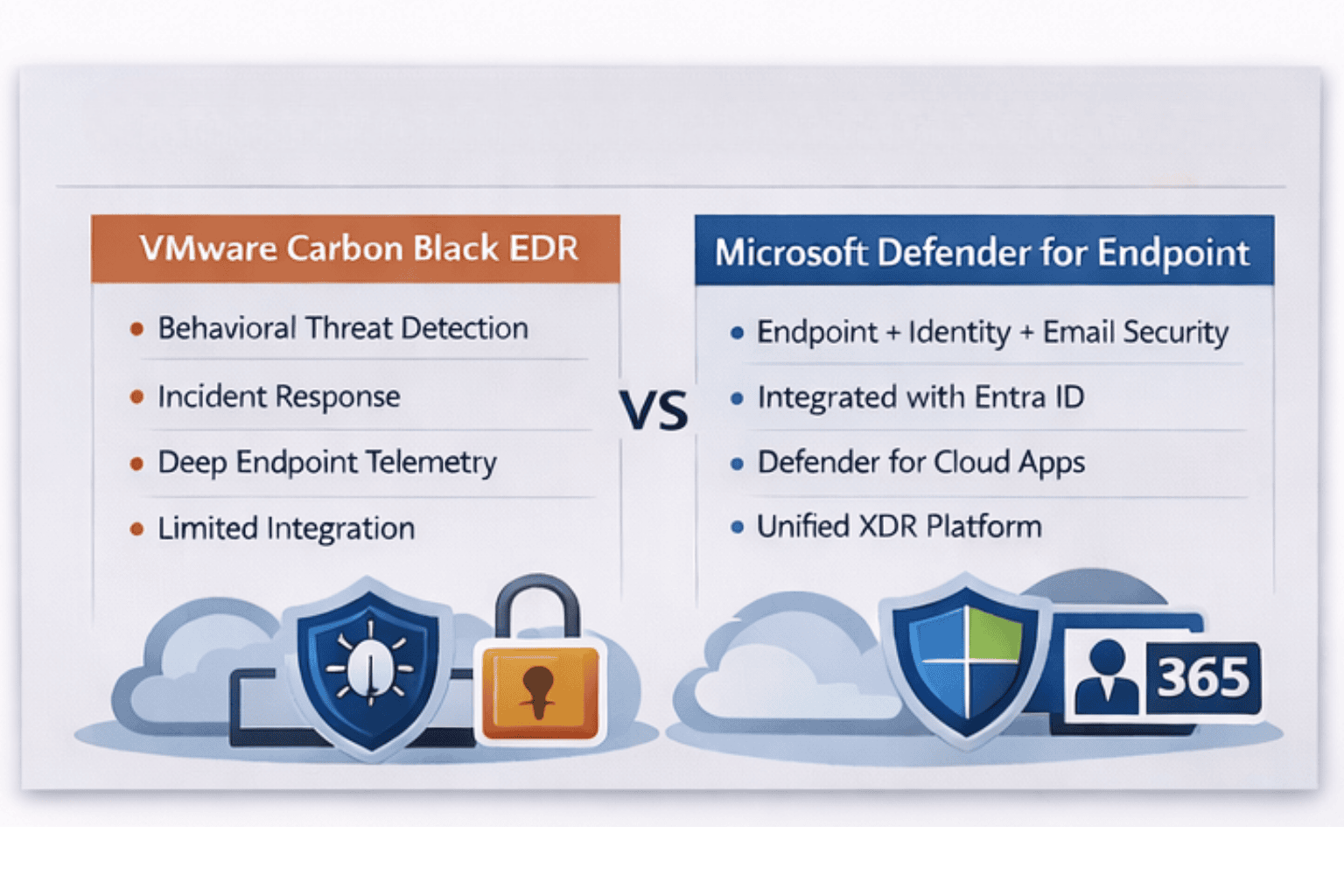
For Microsoft-centric environments, consolidating into Microsoft Defender for Endpoint can reduce tool sprawl, improve cross-domain visibility, and unlock capabilities already included in Microsoft licensing.
Below, we explore where Carbon Black and Defender overlap, where Defender extends further, and what a responsible migration strategy looks like.
Where Carbon Black and Defender Overlap
At the endpoint level, both platforms provide mature protection capabilities.
Carbon Black is known for its strong behavioral detection, threat hunting capabilities, and deep endpoint telemetry. Defender for Endpoint Plan 2 provides similar core EDR functionality including behavioral detection, automated remediation, and advanced threat hunting.
Both platforms support:
Independent evaluations by MITRE ATT&CK show that Microsoft Defender consistently demonstrates broad detection coverage across real-world attack scenarios. Additionally, Gartner has positioned Microsoft as a Leader in the Endpoint Protection Platforms Magic Quadrant for multiple consecutive years.
From a pure endpoint detection perspective, Defender is a strong enterprise-grade alternative.
The strategic advantage emerges when security signals extend beyond the endpoint.
Where Microsoft Defender Extends Beyond Carbon Black
Identity-Driven Security
One of Defender’s biggest advantages is native integration with Microsoft Entra ID.
Identity risk signals, such as compromised credentials or suspicious login activity, can automatically trigger endpoint investigations or Conditional Access restrictions.
In modern attacks, identity compromise is often the first step before ransomware or lateral movement occurs. Defender’s identity-aware security architecture helps detect and contain threats earlier in the attack chain.
Carbon Black can ingest identity telemetry, but it does not control the identity plane.
Email and Collaboration Security
Defender integrates directly with:
This enables automated cross-domain investigation. For example, a phishing email can trigger endpoint investigation, account containment, and incident correlation within a single security portal.
Standalone EDR platforms like Carbon Black typically rely on third-party integrations to achieve similar visibility.
Unified XDR Platform
Microsoft Defender operates as a unified XDR platform, correlating signals across:
Microsoft reports that businesses adopting XDR platforms can reduce mean time to respond (MTTR) by up to 50% compared to siloed security tools.
For security teams managing multiple alerts across different consoles, unified XDR significantly improves investigation efficiency.
In many organizations, Defender capabilities are already included in existing Microsoft licensing.
Defender can fully replace Carbon Black when you have:
Microsoft 365 E5
Includes:
- Defender for Endpoint Plan 2
- Defender for Office 365 Plan 2
- Defender for Cloud Apps
- Entra ID P2
Microsoft 365 E3 + Security Add-ons
Add:
- Defender for Endpoint Plan 2
Microsoft 365 Business Premium
Includes:
- Defender for Business (mid-market EDR)
For businesses already paying for E5, endpoint protection may represent no additional licensing cost, making third-party EDR tools redundant from a budget perspective.
Cost Comparison
| Cost Category | Microsoft Defender (E5 Licensed) | Carbon Black EDR (Standalone) |
|---|---|---|
| Endpoint License Cost | $0 incremental (included in E5) | $40,000–$85,000 annually |
| CASB (Cloud Visibility) | Included (Defender for Cloud Apps) | Separate product required |
| Email Security Integration | Included | Separate tool required |
| Identity Risk Correlation | Included (Entra ID) | Limited / external integration |
| Console Consolidation | Single unified portal | Separate platform |
| Estimated 3-Year Cost | $0 incremental | $120,000–$255,000 |
For businesses already licensed for Microsoft security capabilities, consolidation can represent significant long-term cost avoidance.
How to Migrate from Carbon Black to Defender
A structured migration reduces operational risk and ensures security continuity.
Start by validating licensing to confirm Defender for Endpoint Plan 2 availability. Then deploy Defender alongside Carbon Black in passive mode to compare detection telemetry.
Once Defender visibility is validated, enable integration with identity, email, and cloud apps to activate the full Defender XDR platform.
Security teams should then run controlled attack simulations, such as ransomware exercises or attack simulations, to confirm detection and automated remediation.
After validation, remove the Carbon Black agent in phased deployments across endpoints while monitoring alerts and telemetry.
Finally, tune Defender policies, including:
Frequently Asked Questions
Conclusion
Security platforms are increasingly judged by how well they integrate across the enterprise.
For businesses already invested in Microsoft 365, migrating from Carbon Black to Defender for Endpoint is often less about replacing a security tool and more about consolidating into a unified platform that spans identity, endpoint, email, and cloud applications.
The future of enterprise security isn’t just better detection. It’s better integration.
LEARN MORE ABOUT MIGRATING FROM CARBON BLACK EDR TO DEFENDER

Andrew Reade
Andrew is our Digital Marketing Manager and oversees web-based marketing strategies and content creation for the organization. As a marketing veteran, Andrew has worked with organizations of all sizes in a diverse group of industries, from Risk Management to Transportation. Joining the organization in 2021, Andrew is based in Mobile Mentor’s Nashville, TN office.