
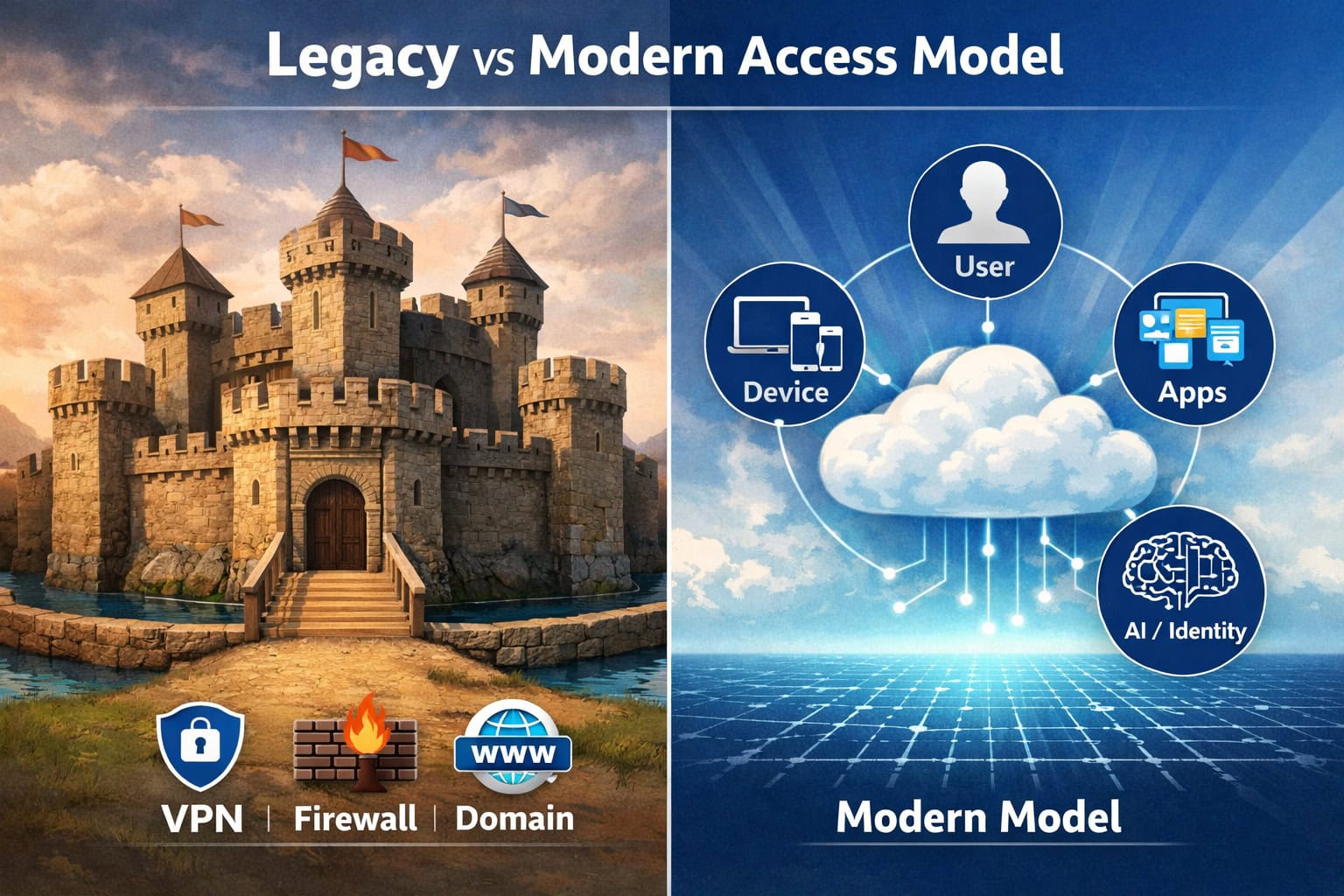
For decades, enterprise access security followed a simple model: keep everything inside a private network, build a strong perimeter, and trust users once they’re in.

That approach gave us VPNs, on-prem domains, and firewalls, and for a long time, it worked.

But access no longer happens on a network. But access no longer happens on a network.

But access no longer happens on a network.

It happens across identities, devices, apps, and APIs, from anywhere. And attackers have adapted. They’re not breaking in—they’re logging in using valid credentials, replaying tokens, and moving through trusted paths.

That’s why access security has shifted, from network enforcement to real-time, intelligent decision making. Conditional Access has become the control plane.

At Mobile Mentor, we summarize it simply: legacy tools assume trust once connected. Modern access evaluates trust continuously.
Where Legacy Access Falls Short

The challenge with legacy access isn’t that it’s broken, it’s that it was built for a different environment.

A VPN, for example, answers one question: is the user authenticated? Once that’s confirmed, everything else is assumed. The device is trusted. The session is safe. The user is who they claim to be. In today’s threat landscape, those assumptions create risk.

On-premises domains were designed for predictable conditions, managed devices, known locations, and controlled networks. Extending that model into the cloud introduces complexity without adding intelligence. Authentication remains binary: credentials are either valid or not. There’s no built-in understanding of risk, behavior, or changing context.

Firewalls face a similar limitation. They’re effective at controlling traffic, but modern access decisions require context, who the user is, what they’re accessing, and whether that behavior makes sense right now. That’s simply outside the scope of what firewalls were designed to do.

Conditional Access Changes the Model

Modern Conditional Access platforms start from a different premise: trust is never static.

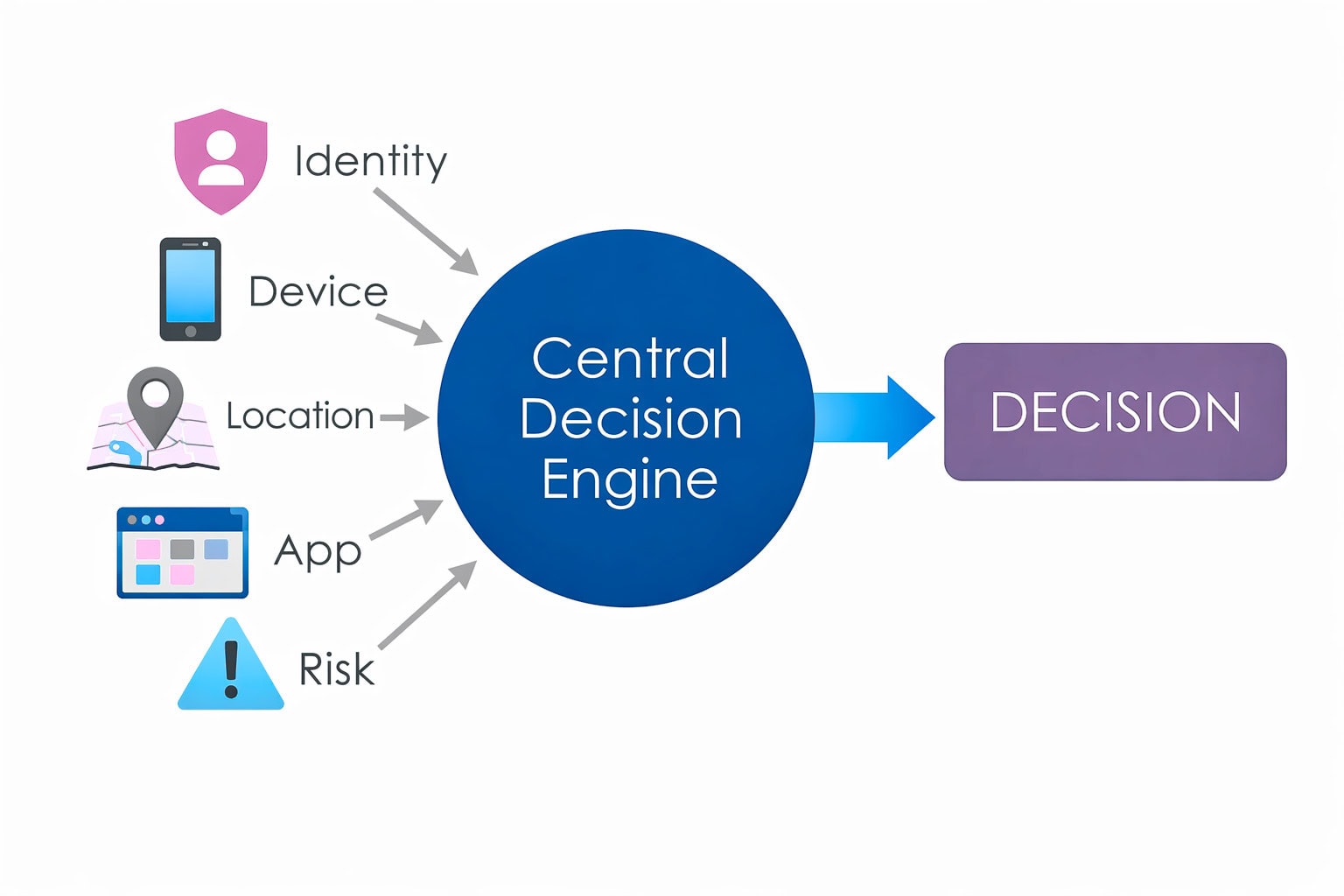
Every access decision considers a combination of identity, device health, location, application sensitivity, and real-time risk. And instead of evaluating once, the system continues to reassess throughout the session.

This is where AI becomes essential. It processes patterns across large volumes of authentication data, identifying anomalies and detecting threats that static policies would miss. Access becomes dynamic—low-risk activity moves smoothly, while higher-risk scenarios trigger additional controls or are blocked entirely.
Why AI Makes the Difference

AI shifts access from fixed rules to adaptive decisions.

It can recognize signals like unusual login behavior, impossible travel, or known malicious infrastructure and use that context to influence access in real time. Each session is evaluated based on risk, not just policy.

Just as importantly, trust is no longer a one-time event. Traditional access models authenticate once and assume everything is fine until the session ends. Modern access continuously re-evaluates. If something changes—like a device falling out of compliance or suspicious activity emerging—access can be adjusted or revoked immediately.

AI also enables a more precise level of control by combining identity, device, and application context. This allows businesses to apply access policies that are far more targeted, without adding unnecessary friction for users.

Why This Matters in the Real World

Most modern attacks don’t rely on breaking through infrastructure. They use valid credentials and legitimate access paths.

That’s where legacy controls struggle. Once access is granted, visibility drops and attackers can move laterally, especially in environments where VPN access opens the door to large portions of the network.

Conditional Access changes that by shifting from network-based access to app-based access. Users are granted access only to what they need, and nothing more. There’s no broad internal network to explore.

At the same time, hybrid work has removed the idea that location equals trust. Access systems need to adapt in real time, balancing security with user experience. AI makes that balance possible.

The Mobile Mentor Perspective

This isn’t about removing VPNs or legacy systems overnight. They still have a role.

But they were never designed to be the primary control for cloud access.

Conditional Access (powered by AI) is.

Organizations that modernize access in this way don’t just improve security outcomes. They also reduce complexity, improve the user experience, and limit the impact of attacks when they occur.

Access Becomes a Living System

The biggest shift here is philosophical.

Legacy access is about preventing entry. Modern access is about continuously validating trust.

Instead of making a single decision at login, access becomes a living system, constantly evaluating signals, adjusting to risk, and responding as conditions change.

Conclusion

This shift isn’t about cloud versus on-prem. It’s about how trust is defined.

The old model connects users to networks and assumes trust after authentication.

The modern model evaluates whether access should exist at all—and keeps evaluating it over time.

That’s the difference.

Download the Six Pillars of Modern Endpoint Management

Learn about features and strategies such as:

  • Zero Trust

  • Passwordless Authentication

  • Zero-Touch Provisioning

  • App Management

  • Over-the-air updates

  • Remote support

Andrew Reade

Andrew Reade

Andrew is our Digital Marketing Manager and oversees web-based marketing strategies and content creation for the organization. As a marketing veteran, Andrew has worked with organizations of all sizes in a diverse group of industries, from Risk Management to Transportation. Joining the organization in 2021, Andrew is based in Mobile Mentor’s Nashville, TN office.