
SCCM (now Microsoft Configuration Manager) has earned its place in enterprise IT. It’s powerful, predictable, and deeply capable—especially in traditional onprem environments.
But endpoint security has changed.
Endpoints aren’t just managed assets anymore, they’re live risk surfaces connected to cloud apps, remote users, mobile networks, and adversaries that move at machine speed. Modern endpoint defense isn’t just “patch, deploy, report.” It’s:
Detect risk in real time
Correlate signals across identity + endpoint + threat
Remediate fast—before users notice and before attackers spread
That’s where Microsoft Intune is pulling away. Not because it’s cloud-based, but because it’s increasingly AI-enhanced and connected to Microsoft’s broader security intelligence.
At Mobile Mentor, we explain it like this:
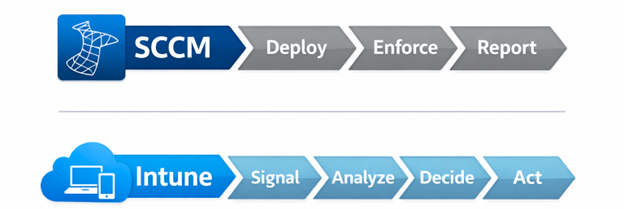
SCCM enforces endpoint configuration.
Intune uses AI + cloud signals to defend endpoints.
SCCM Manages Configuration. Intune Uses AI to Evaluate Trust.
SCCM is excellent at what it was designed for: deploying software, enforcing configurations, and managing Windows devices inside a controlled environment.
Intune’s security advantage is that it operates in a Zero Trust ecosystem, where device trust is continuously evaluated and tied to access decisions. When used with Conditional Access, Intune evaluates whether a device is managed and compliant (encryption, jailbreak/root status, required settings), and it can also incorporate post-breach incident signals coming from Microsoft Defender for Endpoint’s ongoing behavioral analysis.
That “post-breach” piece is the game-changer. Traditional management platforms can confirm whether a setting is configured. They can’t easily answer: Is this endpoint currently under attack?
Intune can, because it’s designed to ingest and act on security signals, not just configuration state.

AI That Improves Decisions: Copilot in Intune
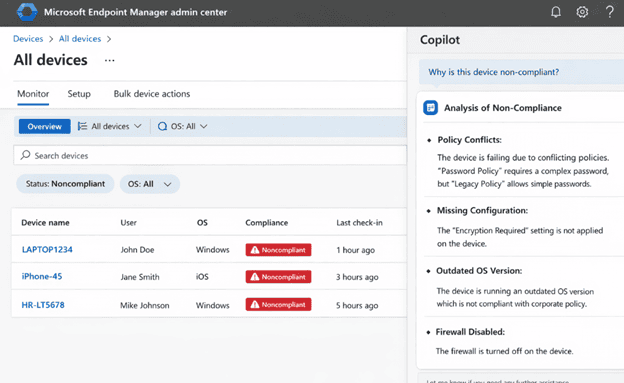
One of the most visible examples of “AI in Intune” is Microsoft Security Copilot integration which is embedded directly in the Intune admin experience and also available via the Security Copilot portal.
Copilot can help teams:
Explore Intune data using natural language
Summarize device and policy posture
Compare a “working” vs “non-working” device
Accelerate troubleshooting and decision-making for endpoint risk and compliance
This matters because endpoint security failures often aren’t caused by a missing tool. They’re caused by:
A missed configuration
A policy conflict
A scope mistake
A delayed response because analysis took too long
AI reduces that operational drag by making the platform easier to interrogate and faster to act in, especially in incidents where minutes matter.
And importantly: this isn’t “random chatbot AI.” It’s AI grounded in your tenant data (devices, policies, assignments, compliance states) to accelerate real admin workflows.

AI Agents: Risk-Aware Guardrails for High-Impact Changes
Intune is also introducing Copilot-powered agents inside the admin center that help reduce human error in sensitive workflows.
One example: the Change Review Agent (designed to support Multi-Admin Approval flows). Instead of an approver manually guessing whether a requested script or change looks risky, the agent can pull together context and signals to provide a recommendation with reasoning—while still keeping the final decision with a human.
This is subtle but important. Endpoint management is full of “high-impact, low-visibility” actions:
scripts
privilege changes
configuration pushes
security setting updates
SCCM can execute these actions. But it doesn’t natively provide AI-driven context and cross-signal correlation to help prevent the wrong change from being approved and deployed at scale.
That’s where Intune is heading: AI to reduce the risk of admin mistakes becoming security incidents.
AI-Driven Analytics: From Reactive Tickets to Proactive Security Hygiene
Most endpoint teams are drowning in tickets:
slow boot times
app crashes
broken VPN/Wi-Fi profiles
OneDrive sync loops
device health regressions after updates
Intune’s Endpoint analytics and Advanced Endpoint Analytics shift the posture from reactive to proactive by providing data-driven insights into device performance, app reliability, and readiness for secure work-from-anywhere scenarios, directly in the Intune admin center.
Where AI shows up: anomaly detection and correlation.
Advanced Endpoint Analytics adds capabilities that use machine learning to detect anomalies and correlate likely root causes (for example, after a configuration change triggers regressions or new crash patterns).
This is more than “DEX.” It’s security too.
Why?
Unhealthy devices are the easiest to compromise
Devices lagging on updates become exploit targets
Reliability issues push users toward insecure workarounds
AI-driven anomaly detection helps teams spot emerging problems early—before they become widespread and before they degrade security posture at scale.
Automated Remediation: Fixing Problems Before They Become Incidents
Intune’s Endpoint Analytics includes the ability to apply remediations based on insights, supporting proactive troubleshooting loops in the admin workflow.
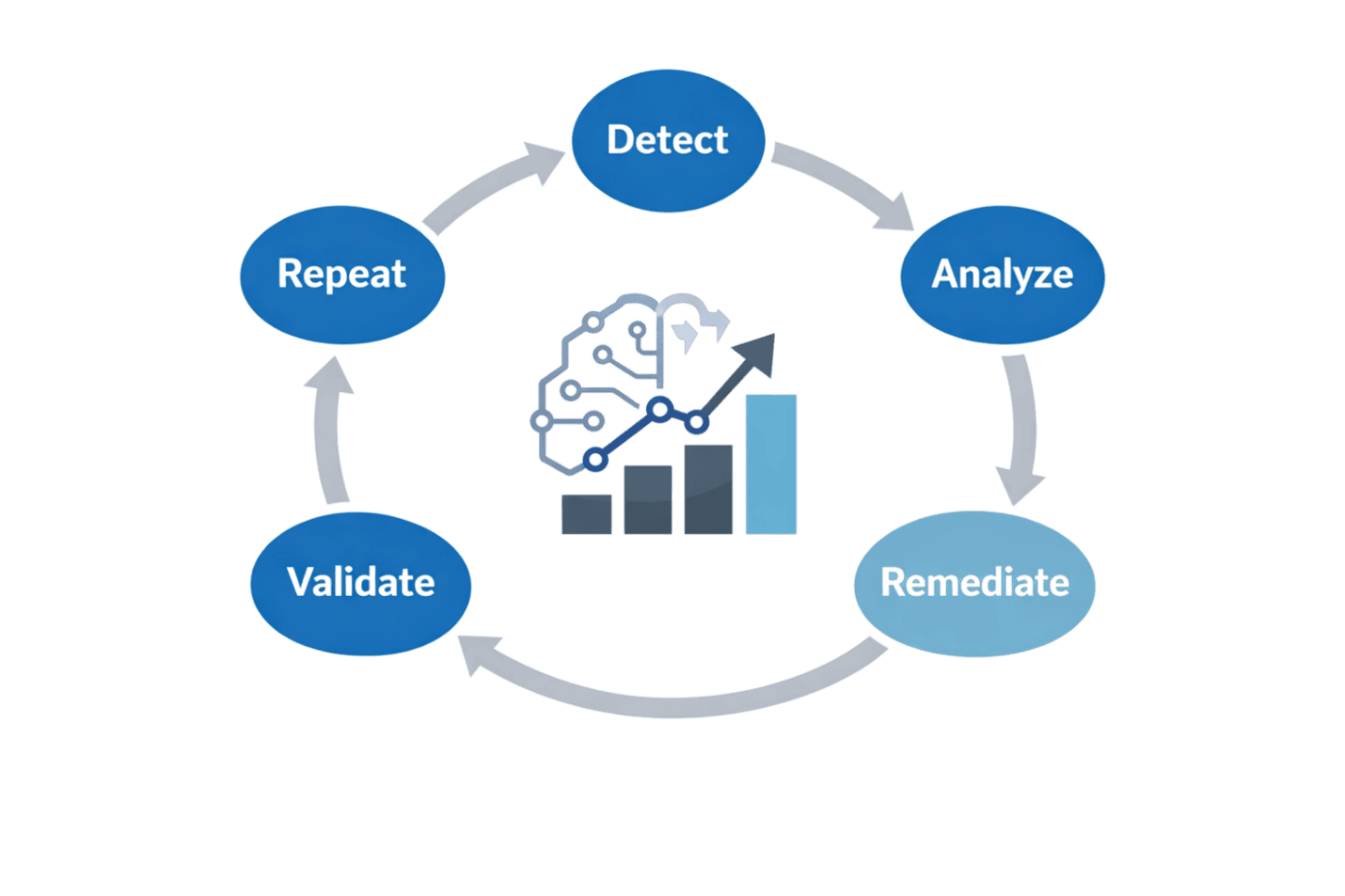
In practice, teams commonly use Proactive Remediations (a scheduled detect-and-fix model) to automatically identify drift and enforce desired state on endpoints—reducing manual intervention and shrinking the window where misconfigurations become vulnerabilities.
SCCM can remediate too, but it tends to rely on:
schedules
collections
compliance baselines
scripting and operational overhead
Intune’s model is increasingly oriented toward continuous signal → insight → remediation, supported by analytics and AI-driven triage.
The Real Difference: Security Is Now Signal-Connected
When customers ask us “Intune vs SCCM for security,” the answer is rarely “pick one and delete the other.” Many environments use co-management during transition.
But the direction is clear:
SCCM is a powerful on-prem management engine.
Intune is a cloud-connected security control point designed to ingest signals and enforce trust.
Conditional Access is a good example of that: Intune can validate compliance and also incorporate active incident signals from Defender for Endpoint for real-time evaluation.
That’s a fundamentally different security model than “deploy a config and hope it stays true.”
Conclusion
This shift goes beyond cloud and on-premises.
It’s really about this:
| Old Model (SCCM) | New Model (Intune) |
|---|---|
| Configuration-first | Risk + signal-first |
| Periodic assessment | Continuous evaluation |
| Manual investigation | AI-assisted investigation |
| Admin-driven decisions | AI-supported guardrails |
| Reactive support | Proactive anomaly detection + remediation |
SCCM enforces endpoint configuration.
Intune uses AI and security signals to defend endpoints.
At Mobile Mentor, we help businesses move to modern management without breaking what works (often through co-management and phased workload migration) while adopting the AI-enhanced security capabilities that make Intune the stronger long-term control plane.
Download the Six Pillars of Modern Endpoint Management
Learn about features and strategies such as:
Zero Trust
Passwordless Authentication
Zero-Touch Provisioning
App Management
Over-the-air updates
Remote support


Denis O'Shea
Denis founded Mobile Mentor in 2004 with a clear purpose – to empower people to achieve more with their technology. The technology is always changing but Denis’ purpose is the same and today most of Denis’s energy is helping clients to navigate the balance between security and employee experience.
Denis is really passionate about solutions that make an impact in healthcare, education and government. Since 2017, Denis has lived in the US, working closely with Microsoft to make a difference at scale.