
Active Directory was one of the most successful enterprise platforms ever built. For decades, it did exactly what it was designed to do: authenticate users inside a trusted network perimeter.
But today’s identity threats don’t respect perimeters, domains, or office walls.
Attackers don’t break in, they log in. And they do it using valid credentials, stolen tokens, and automated tooling at global scale.
That’s why the shift from onprem Active Directory (AD) to Microsoft Entra isn’t just a move to the cloud. It’s a move from static identity security to AIdriven identity defense.
At Mobile Mentor, we see this distinction clearly: Entra isn’t more secure because it’s newer. It’s more secure because it uses AI to make better security decisions in real time.
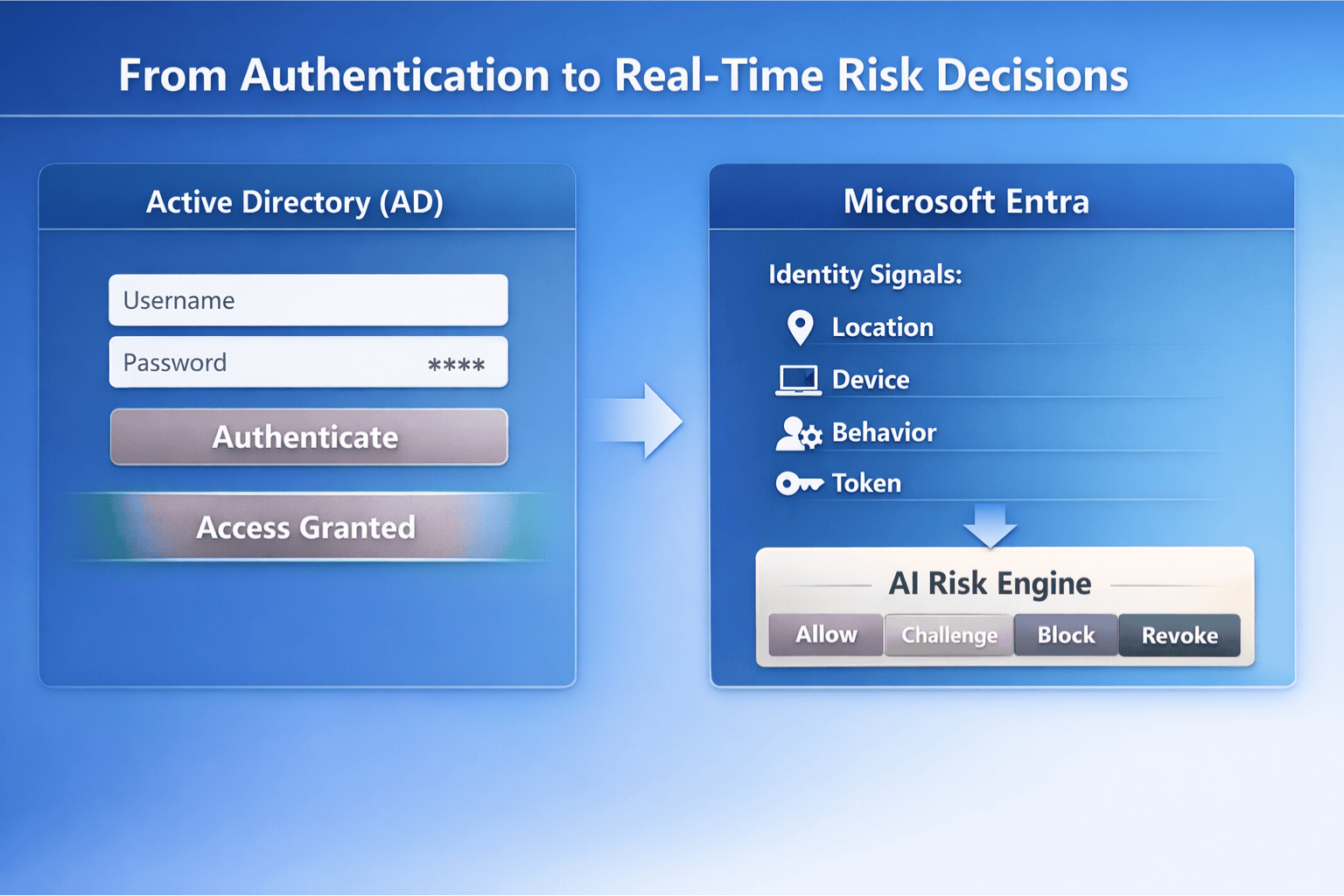
AD Makes Binary Decisions. Entra Uses AI to Assess Risk.
Active Directory answers a simple question: Are the credentials valid?
If the answer is yes, access is granted. Security controls happen later—if at all.
Microsoft Entra answers a different question: How risky is this identity, this signin, right now?
Entra continuously evaluates signins using machine learning models trained on trillions of global authentication signals—including IP reputation, behavioral baselines, leaked credential intelligence, device health, and known attacker infrastructure.
Examples AI routinely catches:
“Impossible travel” between geographies
Signins from anonymizers or bot networks
Credentials known to be leaked but still technically valid
Token replay patterns invisible to traditional logs
In Entra, those events don’t wait for a SOC analyst. AI assigns a risk score and policies respond automatically—block, challenge, or remediate.
AD has no equivalent capability. It cannot learn from global telemetry, correlate behavior across tenants, or reason probabilistically about compromise.
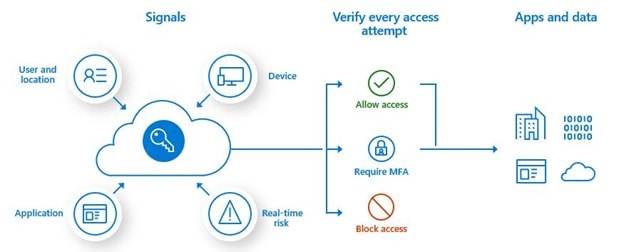
AIDriven Identity Protection vs Static Authentication
Microsoft Entra Identity Protection uses AI to distinguish between:
Risky signins(suspicious authentication attempts)
Risky users(identities likely to be compromised)
That distinction matters because the response can be different—and automatic.
Recent advances like “require risk remediation” go beyond MFA and force deterministic cleanup when AI signals indicate compromise—revoking tokens and requiring identity recovery rather than trusting MFA alone.
This directly addresses modern attack techniques such as:
Adversaryinthemiddle phishing
MFA fatigue attacks
Session and token theft
Active Directory cannot do this. It has no model for identity compromise beyond password resets and lockouts—controls that assume the password is the problem.
Entra’s AI understands that identity compromise is behavioral, not just credential based.
Continuous Access Evaluation: AI That Keeps Watching
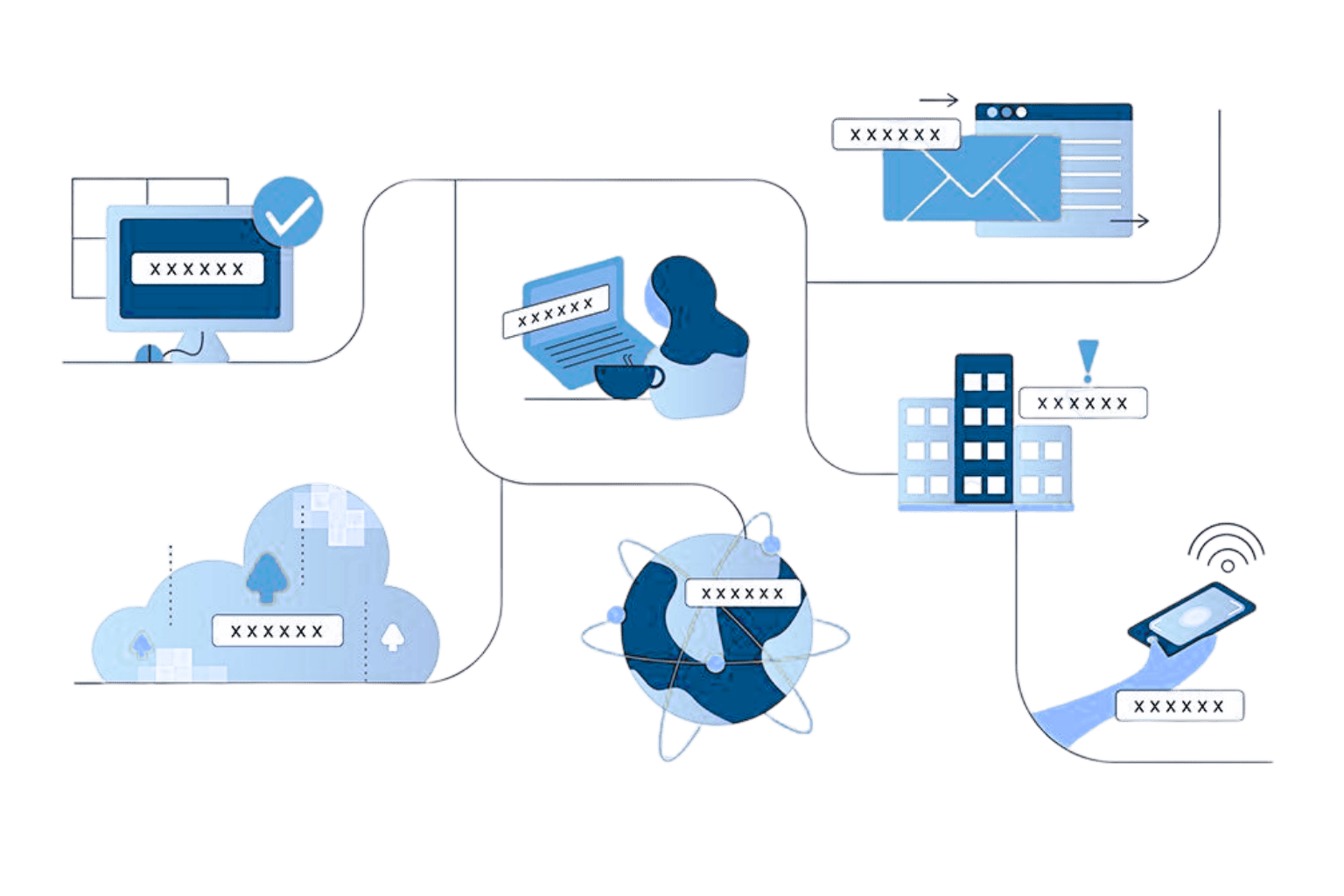
Traditional AD authentication is a moment in time. Once access is granted, trust persists until a ticket expires.
Entra uses Continuous Access Evaluation (CAE) to reevaluate trust after login. If AI signals change—user risk increases, device posture degrades, or suspicious behavior emerges—access can be revoked immediately.
This matters because many attacks:
Begin with a clean sign in
Escalate later
Move laterally quietly
AD cannot react midsession. Entra can—because AI keeps evaluating context continuously. This is Zero Trust implemented as a living system, not a static policy set.
AI That Improves Security Configuration, Not Just Detection
One of the most underappreciated uses of AI in Entra is preventing misconfiguration.
The Conditional Access Optimization Agent uses AI to:
Detect missing baseline security policies
Identify redundant or conflicting rules
Recommend safer policy scopes and conditions
Microsoft reports that organizations using this capability:
Detect policy gaps over 200% more effectively
Complete access hardening tasks faster and with higher accuracy
Group Policy Objects in AD don’t learn. They don’t optimize. They don’t warn you when risk accumulates.
Entra’s AI actively reduces configuration drift, the silent killer of identity security.
AI-Assisted Investigation Without Breaking Trust Boundaries
When incidents do happen, speed matters.
With Security Copilot in Microsoft Entra, security teams can investigate identity incidents using natural language. AI correlates signins, risk detections, role assignments, and access paths into a single, coherent view—without writing complex queries or manually stitching logs together.
Critically:
Copilot operates entirely within Entra RBAC
It cannot access anything the investigator isn’t already authorized to see
All actions are auditable
This is AI accelerating human decision making, not bypassing controls.
Onprem AD investigations still rely heavily on manual analysis and external tooling—effective, but slow in a threat landscape measured in minutes.
AI Governance for NonHuman Identities
Modern environments are full of identities AD was never designed to manage:
APIs
Applications
Service principals
AI agents
Microsoft telemetry shows that over 90% of identities are overprivileged, and more than half of permissions granted are high risk.
Entra uses analytics and AI to identify unused permissions, flag risky access patterns, and recommend leastprivilege models across both human and nonhuman identities.
Active Directory has no native governance model for this problem space. Entra was built for it.
The Real Difference
This isn’t about cloud vs onprem. It’s about this shift:
| Old Model (AD) | New Model (Entra) |
|---|---|
| Authenticate, then trust | Continuously evaluate risk |
| Static rules | AIdriven decisions |
| Manual investigations | AIassisted response |
| Humancentric identities | Humans, apps, and agents |
Active Directory enforces identity rules
Microsoft Entra uses AI to defend identity.
At Mobile Mentor, we help businesses modernize identity with this reality in mind, using AI to improve security outcomes, not just add new tools.
If identity is your control plane, AI isn’t optional anymore. It’s foundational.
More Than Just a Secure Access Management Solution
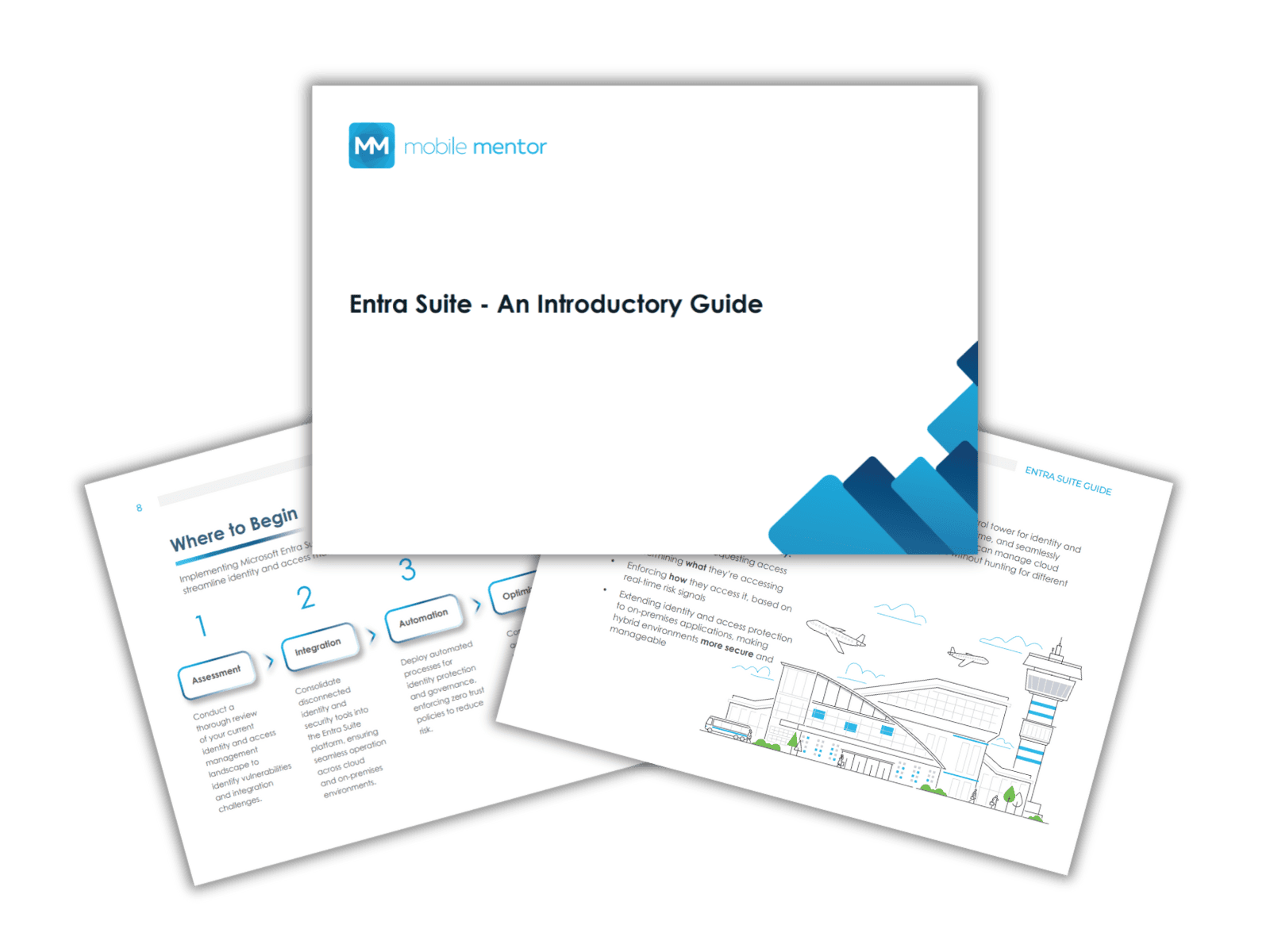
The Entra Suite Guide
Learn about features and strategies such as:
Private Access to enhance protections for on-premises apps and resources without requiring code change.
Internet Access Solution to prevent access to non-compliant and potentially malicious content.
ID Protection providing a foundational risk-based conditional access and multi-factor authentication (MFA) to protect and remediate identity risk.
ID Governance to strike balance between security and productivity by relying on zero trust principles.
Verified ID to enhance user onboarding by integrating with ID Protection and ID governance controls.


Denis O'Shea
Denis founded Mobile Mentor in 2004 with a clear purpose – to empower people to achieve more with their technology. The technology is always changing but Denis’ purpose is the same and today most of Denis’s energy is helping clients to navigate the balance between security and employee experience.
Denis is really passionate about solutions that make an impact in healthcare, education and government. Since 2017, Denis has lived in the US, working closely with Microsoft to make a difference at scale.