
At the Bottom: The Dirty Data We Already Have
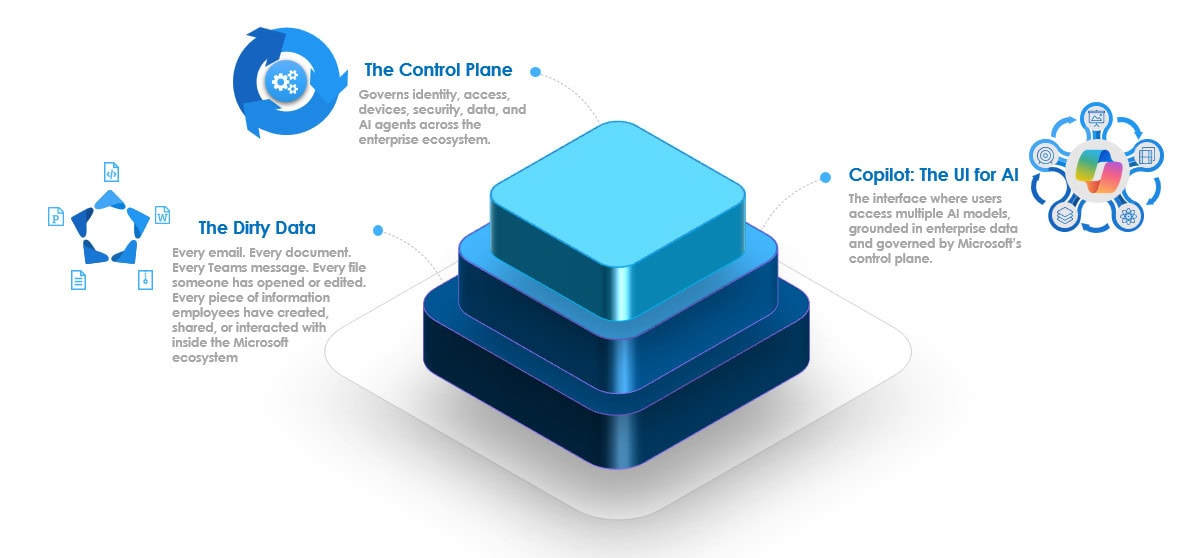
At the foundation of the pyramid is a business’s enormous volume of unstructured data.
Every email. Every document. Every Teams message. Every file someone has opened or edited. Every piece of information employees have created, shared, or interacted with inside the Microsoft ecosystem.
This data isn’t necessarily clean or organized. It’s the “dirty data” accumulated through years of work.
But it is incredibly valuable to AI.
The more effectively AI can reason over this information, the more useful it becomes to employees and organizations. And for many Microsoft 365 customers, much of that information already exists within Microsoft’s ecosystem.
At the Top: The Control Plane
At the other end of the pyramid is the control plane. This is the layer that determines who has access to what, which agents are trusted, what data can be shared, and what security policies apply.
This is the battle ground where Microsoft has consistently won out over time, especially when we think about the control plane for identity, endpoints and security.
Identity has moved from traditional Active Directory to cloud-based Microsoft Entra with a broad set of tools enabling enterprises to eliminate passwords and improve security.
Intune provides a control plane for devices across Windows, macOS, iOS, Android, BYOD, and even virtual machines.
Defender now has 17 different products across the security landscape and Microsoft Purview is becoming the default platform for data classification, sensitivity labels, DLP, and data security policies.
The next major battleground may be AI agents.
As organizations move from simply asking AI questions to deploying agents that can take actions on their behalf, those agents will need identities, permissions, security policies, governance, and lifecycle management.
That’s where a control plane such as Microsoft’s Agent 365 becomes increasingly important.
The combination of Entra, Intune, Defender, Purview and Agent 365 provides the control plane at the apex of the enterprise AI ecosystem.
In the Middle: Copilot – the UI for AI
Between the control plane and the organization’s data sits Copilot.
Copilot is the interface to AI .
And importantly, the value isn’t necessarily tied to a single underlying model. Copilot gives users access to the latest models from Open AI and Anthropic. For example, you can select Claude to do a task and have ChatGPT review it, or vice versa. You can run two model side-by-side and chose the better output. Very powerful.
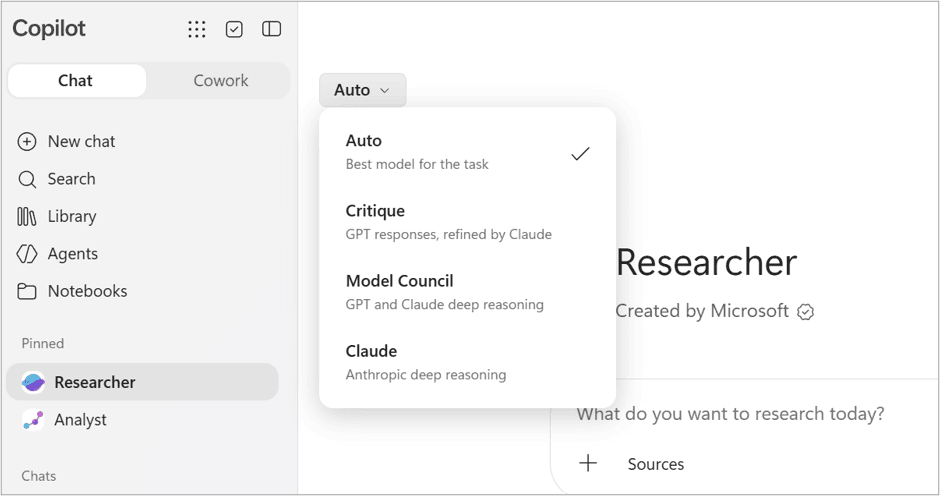
The AI landscape is moving quickly. New models will continue to emerge, and organizations will want access to the best models for different use cases.
The opportunity for Microsoft is to make those models accessible through the Copilot experience while maintaining the identity, security, permissions, and governance inherited from the control plane, and reasoning over all the unstructured data in the enterprise.
That creates a powerful architecture:
Control plane → Copilot → organizational data
The control plane establishes the rules. Copilot provides the interface to AI. And the data provides the context that makes AI useful.
The Model May Become Less Important
This doesn’t mean models don’t matter.
They absolutely do.
There will continue to be breakthroughs, new models, and intense competition between AI companies. The latest model will continue to generate headlines and excitement.
But over time, the model itself could become less important than the platform surrounding it.
If businesses can access multiple leading models through a common interface (and those models can reason over organizational data while inheriting the business’s existing security and permissions) the underlying model becomes increasingly interchangeable.
The platform becomes the differentiator.
That’s a very different kind of AI competition.
Why This Matters for Businesses
For organizations already invested in Microsoft 365, this creates an important strategic consideration.
The AI conversation shouldn’t be limited to “Which model should we use?”
It should also include:
AI at scale requires more than intelligence. It requires identity, security, governance, data, and control.
That is where the Microsoft ecosystem could become particularly powerful.
The Real AI Battle Ground will be the Ecosystem
The long-term AI winner may not be the company with the single best model.
It may be the company that can connect the most important pieces of the enterprise AI stack:
Data at the bottom.
Control at the top.
AI in the middle.
Microsoft already has a significant presence across each of those layers.
If that architecture continues to mature, Copilot could become much more than an AI assistant. It could become the primary interface through which employees interact with organizational knowledge, applications, workflows, and increasingly autonomous AI agents—all within a framework of identity, security, permissions, and governance.
The models will continue to evolve.
But the platform that securely connects people, data, devices, identity, security, and AI may ultimately matter much more.
And that’s why the biggest AI battle may not be about who builds the smartest model.
It may be about who controls the ecosystem around it.
AI at scale requires more than intelligence. It requires identity, security, governance, data, and control.
That is where the Microsoft ecosystem could become particularly powerful.