

Image source: Apple Inc., MacBook Neo. Retrieved from https://www.apple.com/macbook-neo/
For years, Macs have had a strange position in the enterprise. Employees love them. IT teams often tolerate them. But they've rarely been the default device in corporate environments.
That dynamic may be about to change.
Apple's newly announced MacBook Neo, a $599 entry-level MacBook, introduces something the enterprise market hasn't really seen before: a truly affordable Mac that still benefits from Apple's full ecosystem advantage. If the device performs as expected, it could challenge long-held assumptions about cost, management, and performance, and potentially accelerate Mac adoption across the enterprise space.
Just as importantly, modern management platforms like Microsoft Intune now allow businesses to manage Macs alongside Windows and other endpoints with the same policies, security controls, and lifecycle management.
Put together, this raises an interesting question: Is the MacBook Neo the device that finally pushes Macs into the enterprise mainstream?
Why Macs Have Historically Struggled in the Enterprise
Despite strong popularity with consumers and developers, Macs have traditionally made up roughly about 5% of enterprise endpoints.
There are three primary reasons for this.
-
The Cost Perception
Macs have always carried a higher upfront price than most Windows laptops. Even though Macs often last longer, IT purchasing decisions are typically made based on initial capital expense rather than total lifecycle cost.
That pricing perception alone has historically been enough to disqualify Macs in many enterprise procurement discussions.
However, this dynamic may now be shifting. In recent years, the cost of PC components and supply chains has become more volatile, pushing the price of many Windows laptops higher. Meanwhile, Apple’s vertical integration and silicon strategy have allowed it to deliver increasingly powerful hardware at lower price points.
The introduction of the $599 MacBook Neo significantly changes the starting point for those cost comparisons.
-
Management Complexity
Historically, managing Macs required a separate toolset, most commonly Jamf.
While Jamf is a powerful platform, it created an operational problem for IT teams:
- One toolset for Windows devices
- Another toolset for Macs
- Separate expertise and workflows
For businesses already stretched thin, this added friction.
-
IT Support Friction
Because Macs were less common, they were often seen as the “special case device.”
Supporting them meant additional troubleshooting knowledge, unique deployment workflows, and different patching or configuration strategies. Even when the experience wasn’t actually worse, the perception remained that Macs were harder to support.
The Inflection Point: Why This Could Change
Several trends are converging that could dramatically alter this equation.

Image source: Apple Inc., MacBook Neo. Retrieved from https://www.apple.com/macbook-neo/
Affordable Macs Are Finally Here
The MacBook Neo starts at $599, with education discounts dropping the price even lower.
At this level, the device begins competing directly with:
This dramatically weakens the biggest objection Macs have faced in enterprise procurement: price.
Even more importantly, Mac longevity often shifts the cost equation.
| Device | Starting Price |
|---|---|
| MacBook Neo | $599 |
| Entry Windows Laptop | ~$600–$900 |
| Chromebook | ~$300–$600 |
But the more important lens for CIOs and IT leaders isn't just the purchase price. It's Total Cost of Ownership (TCO).
When evaluating devices over a three- to five-year lifecycle, several Mac advantages often come into play:
When those factors are considered together, the total cost of a Mac has often been closer to a PC than many businessess assume. With a $599 starting price, that equation becomes even more compelling.
A Viable Choice for Enterprise Workloads
The MacBook Neo is not designed to replace high-performance developer machines or creative workstations. But it may not need to.
For many enterprise roles, the workload is increasingly simple:
In these scenarios, a device that performs "good enough" while offering strong battery life and reliability can be extremely appealing.
That makes the Neo particularly interesting for:
Bridging the Windows App Gap
One of the traditional limitations of Macs in the enterprise has been access to Windows-only applications, particularly legacy line-of-business software.
But that limitation is increasingly being addressed through Windows 365.
With Windows 365, organizations can stream a full Windows desktop from the cloud to virtually any device, including a Mac. That allows users to access Windows applications, legacy systems, and specialized workloads that don't run natively on macOS.
In practice, this creates an interesting hybrid model:
For many businesses, this removes one of the last major barriers to introducing Macs into broader enterprise environments.
The Role of Microsoft Intune
One of the biggest barriers to enterprise Mac adoption used to be management. That barrier has largely disappeared.
Microsoft Intune now allows businesses to manage Macs alongside Windows devices using the same platform.
That includes:
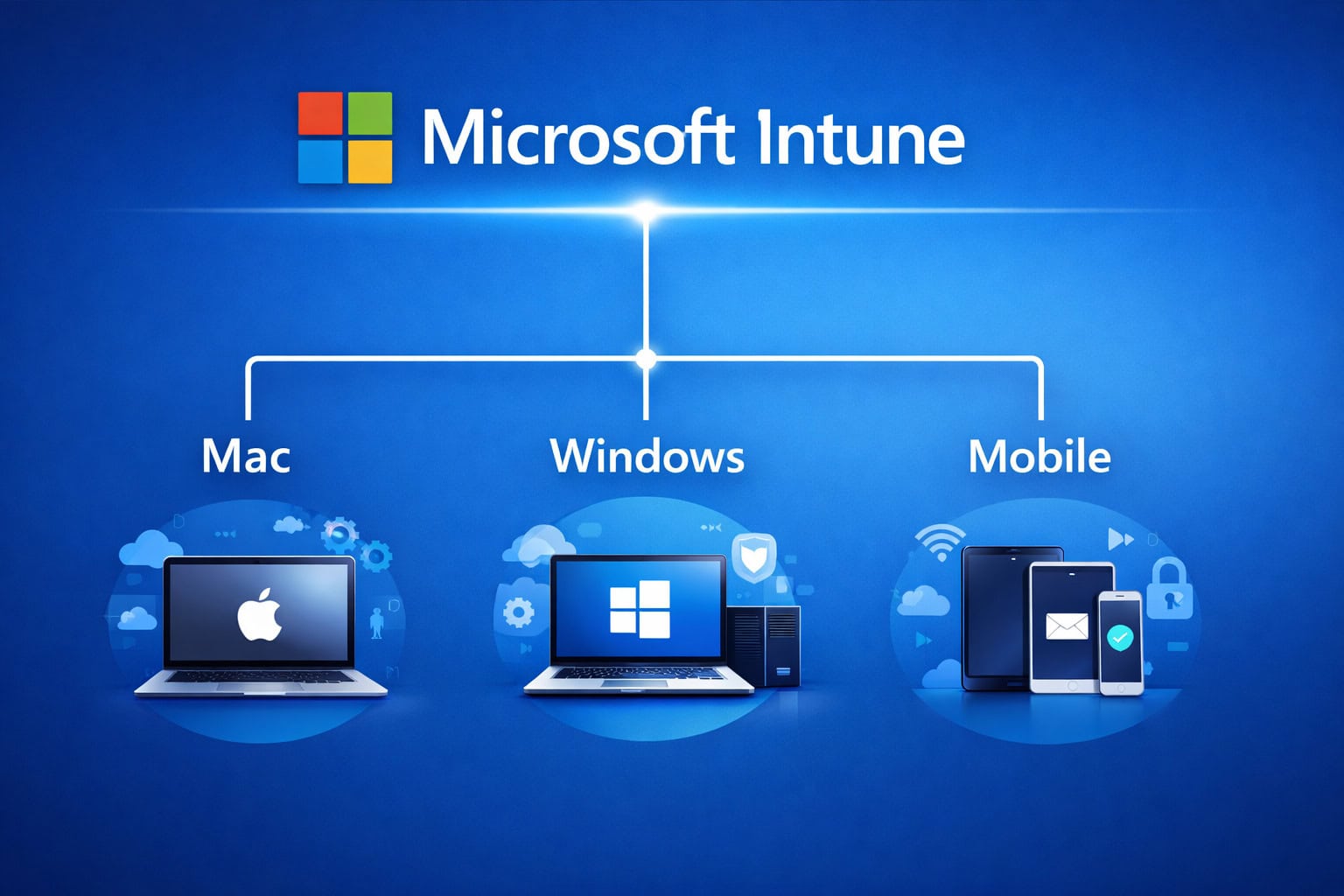 For IT teams already using Intune to manage Windows endpoints, Macs no longer require a completely separate ecosystem.
Even better, Intune can also manage Chromebooks and other device types, allowing businesses to consolidate endpoint management across multiple platforms.
This creates a much simpler model with one management platform supporting
Multiple device choices. That’s a powerful shift for enterprises.
The Rise of Employee Device Choice
If cost, management, and security become comparable between platforms, another trend becomes more viable:
Employee device choice.
Instead of dictating a single device standard, businesses may increasingly allow employees to select Mac, Windows or in some cases, Chromebooks.
From IT's perspective, the key questions remain:
With modern management platforms like Intune, the answer to those questions is increasingly yes across multiple device types. And there is no shortage of employees who strongly prefer Macs.
Expanding the Enterprise Device Strategy
For businesses that have historically standardized exclusively on Windows devices, the MacBook Neo presents an interesting strategic question.
If a Mac can:
Then the rationale for excluding Macs becomes harder to justify. This doesn't mean every enterprise will switch. But it may mean that Macs become a much more viable option for many businesses.
The Next 5–10 Years
Mac adoption in the enterprise is unlikely to change overnight. But the underlying barriers that once limited adoption are steadily disappearing.
Taken together, these shifts could drive a meaningful increase in enterprise Mac adoption over the next decade.
The MacBook Neo may not replace every corporate laptop. But it could be the device that finally opens the door wider for Macs in the enterprise. And once that door opens, the floodgates may follow.
LEARN MORE ABOUT INTUNE FOR MACOS

Andrew Reade
Andrew is our Digital Marketing Manager and oversees web-based marketing strategies and content creation for the organization. As a marketing veteran, Andrew has worked with organizations of all sizes in a diverse group of industries, from Risk Management to Transportation. Joining the organization in 2021, Andrew is based in Mobile Mentor’s Nashville, TN office.