

AI is making it easier for employees to turn ideas into working applications. Here’s how businesses can take advantage of these new capabilities while keeping data, security, and governance in focus.
Building an application has traditionally required a combination of technical skills, development resources, and time. Microsoft’s latest capabilities in Copilot Studio and Copilot Cowork are designed to lower that barrier, helping more people turn everyday business challenges into practical applications with the help of generative AI.
For those looking to get more value from AI, this creates new opportunities for productivity and innovation. It also raises important questions about how applications are created, what data they can access, and how IT teams maintain control.
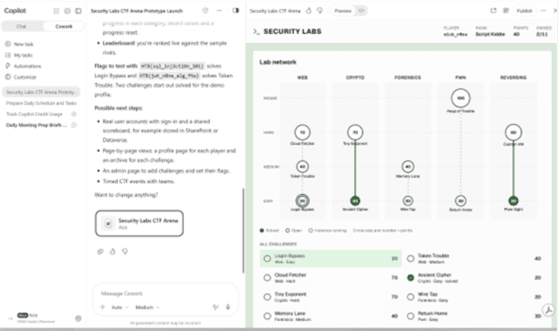
From an Idea to a Working App Through Conversation
With these new experiences, employees can use natural-language prompts to describe what they want an application to do. Rather than starting with code or a complex development environment, they can work with AI to create an initial version, refine its functionality, preview the results, test the experience, and publish or share the finished app.
This approach can help business users address operational challenges without waiting for a traditional development project.
For example, an employee might want to build an application that helps a team track project requests, organize internal processes, or simplify routine data entry. Instead of relying on spreadsheets or requesting a custom application from IT, they can use conversational guidance to develop a working starting point.
The potential benefits include:
The result is a broader range of people participating in application development, with AI helping bridge the gap between a business need and a technical solution.
Connecting Apps to Organizational Data
The value of an application often depends on the information it can access. An app that operates in isolation may have limited usefulness, while one that connects to relevant business data can support more meaningful workflows.
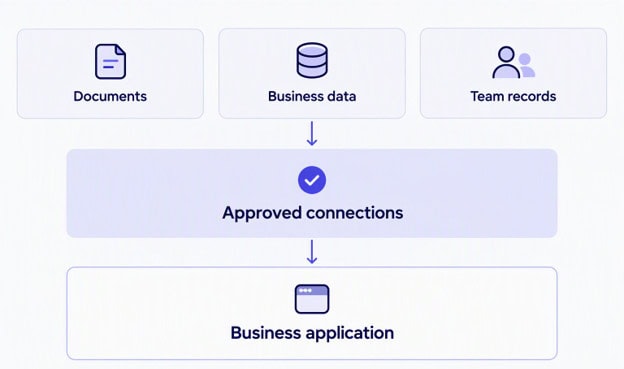
These new experiences can use organizational data through connectors permitted by your organization’s policies. That creates opportunities to build applications around existing business processes and information sources.
However, access to organizational data introduces important considerations.
An AI-assisted development experience does not automatically make an application secure, compliant, or appropriate for every user. Businesses still need to understand which data sources are available, what permissions apply, and whether the resulting application handles information appropriately.
Before employees begin connecting applications to business data, IT and security teams should evaluate the controls governing those connections.
The Governance Challenge: More Apps, More Responsibility
Making application development easier can help businesses move faster. It can also increase the number of applications created across the business, including applications that IT may not initially know exist.
This is where governance becomes essential.
When employees can build and share applications through conversational AI, businesses need a clear approach to managing what gets created, who can access it, and how it interacts with corporate systems.
Consider these areas of focus:
-
Establish Clear Development Guidelines
Define who can create and publish applications, which environments they can use, and what approval is required before an app is shared more broadly.
Not every application needs the same level of oversight. A simple personal productivity tool may carry different risks from an application that processes sensitive customer information or supports a critical business workflow.
-
Review Data Access and Permissions
Ensure that connectors and data sources follow your organization’s existing access policies. Applications should only expose information to users who are authorized to access it.
Review how permissions are assigned and whether the resulting application could unintentionally make sensitive information available to a wider audience.
-
Apply Existing Security Controls
Application development through AI should fit within your established identity, endpoint, and data security strategy.
Use appropriate access controls, data protection policies, monitoring, and security reviews to help ensure applications operate within approved boundaries. Where necessary, establish additional safeguards for applications that handle sensitive information or support important business processes.
-
Define Testing and Publishing Requirements
AI can accelerate the creation of a working first draft, but that does not mean the application is ready for production.
Before publishing, validate the application’s functionality, permissions, data handling, and expected behavior. Establish clear ownership so someone remains responsible for maintaining the application as business needs and security requirements change.
-
Give Employees Practical Guidance
Employees do not need to become professional developers to benefit from these tools. They do, however, need to understand the expectations for data use, application sharing, and responsible AI adoption.
Provide clear guidance on what employees can build, which information they can use, and when they should involve IT or security teams.
Build Faster Without Losing Control
AI-assisted application development represents another step toward making technology more accessible across the organization. Employees can move from identifying a problem to creating a potential solution with less dependence on traditional development resources.
For IT teams, the goal is not to prevent employees from using these capabilities. It is to create an environment where they can experiment productively while protecting organizational data and maintaining appropriate oversight.
That requires a combination of clear policies, secure access to data, practical employee guidance, and ongoing application governance.
The opportunity is to give employees more ways to solve business problems while ensuring every new application fits within your business’s security and compliance requirements.
With the right foundation in place, businesses can encourage innovation, improve productivity, and get more value from AI without losing sight of the controls that keep their environment secure.


Matt Schmidt
Matt is our Vice President Global Customer Experience, Managed Services. Prior to joining Mobile Mentor, Matt spent 23 years building Ease Technologies into a world class MSP that was purchased by Thrive Networks back in 2020. Joining Thrive, Matt lead the team of v-CIOs in the Mid-Atlantic region while managing some of the largest customers in Thrive’s portfolio.